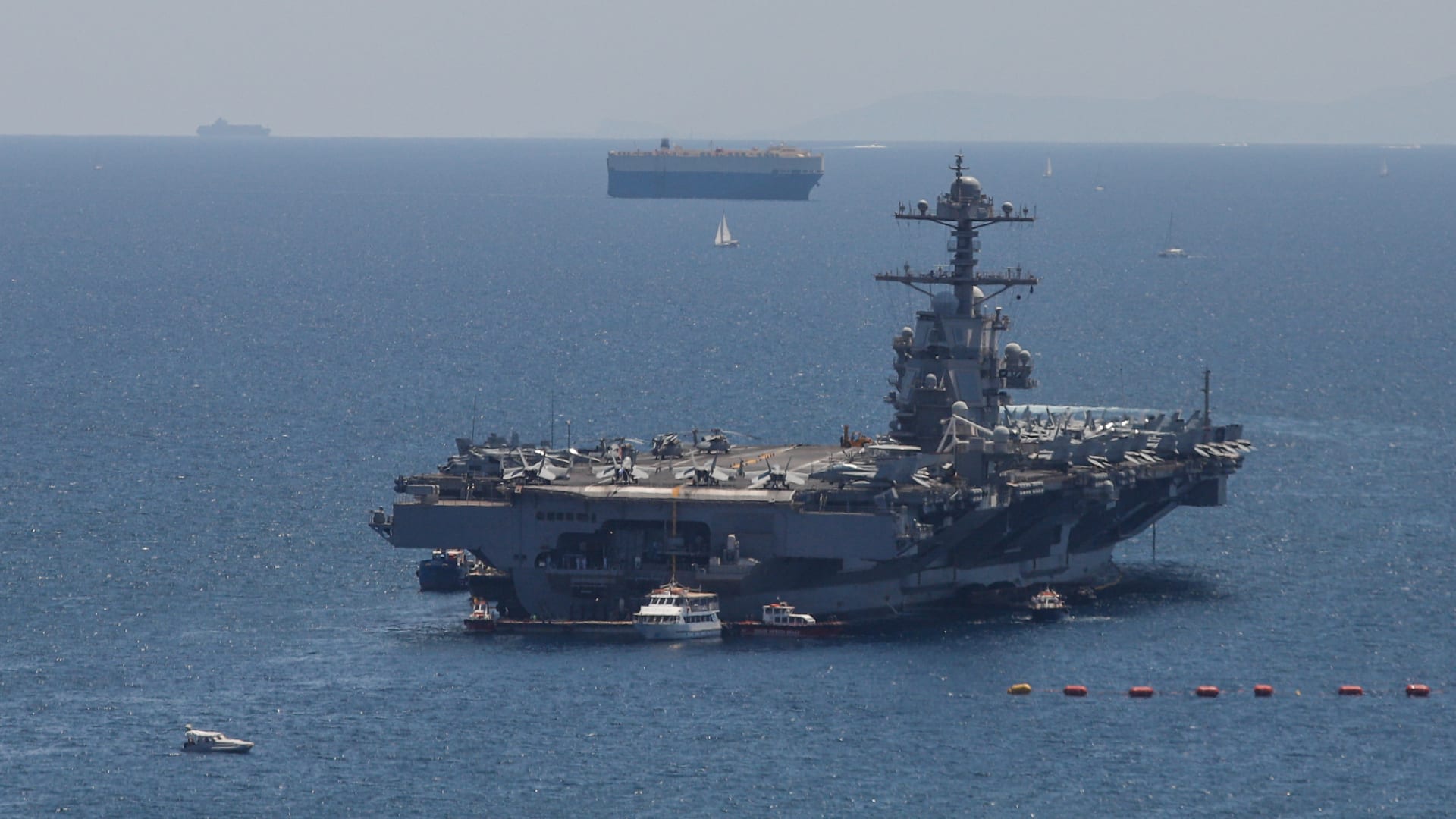
حاملة الطائرات الأمريكية "فورد" ستغادر البحر المتوسط.. وواشنطن توضح وجهتها
حاملة الطائرات الأمريكية "فورد" ستغادر البحر المتوسط.. وواشنطن توضح وجهتها
دبي، الإمارات العربية المتحدة (CNN)– أعلنت البحرية الأمريكية، الاثنين، أن حاملة الطائرات جيرالد آر. فورد التي تم إرسالها إلى شرق البحر الأبيض المتوسط لـ”المساهمة في الردع الإقليمي”، وذلك في أعقاب هجوم حركة “حماس” على إسرائيل في 7 أكتوبر/ تشرين الأول، ستعود إلى قاعدتها الأصلية في الولايات المتحدة.
وقال الأسطول السادس الأمريكي، في بيان نشره على موقعه الإلكتروني، إن الأوامر صدرت لحاملة الطائرات بـ”التوجه إلى شرق البحر الأبيض المتوسط للمساهمة في الردع الإقليمي ووضعنا الدفاعي”،…
Nobel Peace Prize winner sentenced to six months in jail in Bangladesh | World News
Nobel Peace Prize winner sentenced to six months in jail in Bangladesh | World News
A Bangladeshi court has sentenced a Nobel Peace Prize winner to six months in jail – after more than 170 world leaders and Nobel laureates called for the legal proceedings to be suspended.
Muhammad Yunus, who pioneered using microcredit to help impoverished people, was accused of violating the country’s labour laws and was granted bail at the hearing in Dhaka today. He has 30 days to appeal.
Grameen Telecom, which he founded as a non-profit organisation, is at the centre of the trial.
The head of the Third Labour Court of Dhaka said in her verdict that 67 of Grameen Telecom’s employees were supposed to be made permanent and that the employees’ participation and welfare funds were not formed.
Sheikh Merina Sultana also said that, following company policy, 5% of the company’s dividends were supposed to be distributed to staff.
She found Yunus, as chairman of the company, and three other company directors guilty, sentencing each to six months in jail.
Grameen Telecom owns 34% of the country’s largest mobile phone company, Grameenphone, a subsidiary of Norway’s telecom giant Telenor.
The Nobel laureate is also facing several other charges involving alleged corruption and fund embezzlement.
Image: Muhammad Yunus gestures outside court in Dhaka after being sentenced to six months in prison
Yunus’s supporters believe the charges were filed to harass him amid a wider complex political context and frosty relations with Prime Minister Sheikh Hasina. Bangladesh‘s government has denied the allegations.
In August, global leaders including former US president Barack Obama, former UN secretary general Ban Ki-moon and more than 100 Nobel laureates urged Ms Hasina to suspend all legal proceedings against Yunus.
The group said in a letter that they were deeply concerned by recent threats to democracy and human rights in Bangladesh.
Yunus founded Grameen Bank in 1983 which gives small loans to entrepreneurs who would not normally qualify for bank loans. The bank’s success in lifting people out of poverty led to similar microfinancing efforts in many other countries.
Ms Hasina’s administration began a series of investigations into Yunus after she came to power in 2008.
At that time, he had criticised politicians in the country, saying they were only interested in money, while Ms Hasina called him a “bloodsucker” and accused him of using force and other means to recover loans from poor rural women as head of Grameen Bank.
Read more from Sky News: Trump has ‘high chance of conviction’ Who is set to be Denmark’s new monarch? Tsunami warning as earthquake hits Japan
Image: Bangladeshi Prime Minister Sheikh Hasina in October
In 2011, Ms Hasina’s administration began a review of the bank’s activities. Yunus was fired as managing director for allegedly violating government retirement regulations.
He was also put on trial in 2013 on charges of receiving money without government permission, including his Nobel Prize award and royalties from a book.
Bangladesh is holding a general election on 7 January but the country’s main opposition the Bangladesh Nationalist Party, led by former prime minister Khaleda Zia, is boycotting the vote.
The party said it does not have any confidence in Ms Hasina’s administration to hold a free and fair election.
Israel’s Supreme Court strikes down controversial law rolling back judicial powers | World News
Israel’s Supreme Court strikes down controversial law rolling back judicial powers | World News
Israel’s Supreme Court has struck down a controversial law passed by Prime Minister Benjamin Netanyahu’s right-wing government that rolled back some of the high court’s power and sparked nationwide protests.
The new legislation had removed one of the methods by which the Supreme Court can quash government and ministers’ decisions.
The law would have stripped the court of its ability to void such decisions that it deemed “unreasonable”.
Opponents had argued that the legislation may open the door to corruption and improper appointments of unqualified allies to important positions.
Eight of 15 justices ruled in favour of nullifying the law, the court said in a statement, and added that they ruled to strike down the law because it would severely damage Israel‘s democracy.
The proposed legislation, passed in July, was part of a broader judicial overhaul proposed by Netanyahu and his coalition of religious and nationalist partners which caused a deep rift in Israel and concern over the country’s democratic principles among Western allies.
Image: Israelis take to the streets in July to protest against the controversial legislation
Those divisions were largely put aside while the country focuses on the war in Gaza but today’s court decision could reignite those tensions, which sparked months of mass protests against the government and had rattled the cohesion of the powerful military.
More on Benjamin Netanyahu
Netanyahu’s Likud party said the decision was unfortunate and that it opposed “the will of the people for unity, especially during wartime”. Opposition lawmakers praised the ruling.
Please use Chrome browser for a more accessible video player
1:19
Israeli refuses to serve in army
It comes as Israel pulled five brigades, amounting to several thousand troops, from Gaza in the first significant drawdown of soldiers since 7 October.
What will the Supreme Court’s decision mean for Israel now?
Even before the attacks on 7 October, which could yet redefine the shape and balance of the Middle East, 2023 was already one of the most consequential in Israel’s 75-year history.
Benjamin Netanyahu, beholden to far-right elements in his coalition and running from court cases lingering over him, had begun pushing through major controversial reforms to the country’s judiciary with the aim of rebalancing legislative power in favour of the government.
Then 7 October happened – what does the Supreme Court’s decision mean for Israel now?
Read in full here
There were several other developments in the Israel-Hamas war as New Year’s Day came to a close:
• Israel also pulled tanks out of some Gaza City districts today, residents said, as it announced plans to shift tactics and cut back on troop numbers; • The US said this signalled the start of a shift to lower-intensity operations in northern Gaza • Hezbollah said three of its fighters were killed in southern Lebanon; • Also in Lebanon, the Israeli military said it struck Hezbollah targets and that five soldiers were wounded by cross-border fire; • Hamas fired a large barrage of rockets towards Israel, including its commercial hub Tel Aviv, as the clock struck midnight on New Year’s Eve; • Israel’s defence minister says some communities that had been evacuated to the north of the Gaza Strip will be able to return soon; • The US Navy said it will end the deployment of the Gerald R Ford aircraft carrier in the Middle East which started after the 7 October attack
What does the Israeli Supreme Court decision mean for Netanyahu’s government – and its adversaries? | World News
What does the Israeli Supreme Court decision mean for Netanyahu’s government – and its adversaries? | World News
Even before the attacks on 7 October, which could yet redefine the shape and balance of the Middle East, 2023 was already one of the most consequential in Israel’s 75-year history.
Benjamin Netanyahu, beholden to far-right elements in his coalition and running from court cases lingering over him, had begun pushing through major controversial reforms to the country’s judiciary with the aim of rebalancing legislative power in favour of the government.
In a nation that has no written constitution and no upper chamber of parliament, the Supreme Court is seen as the one check on executive power.
Over months, protests against the government grew in size to the point where hundreds of thousands of people were turning out on Saturday evenings across Israel in opposition to what they feared was a move towards dictatorship.
Please use Chrome browser for a more accessible video player
2:48
Why are there protests about the judiciary in Israel?
The Israeli economy took a major hit, the Shekel collapsed against the dollar, investment was deferred and foreign companies waited to see how things would play out. Thousands of reserve soldiers and air crew went on strike, putting the security of Israel in jeopardy.
Undeterred, Netanyahu and his government ploughed on, finally passing the first major reform in July.
The Reasonableness Bill removed the power of the Supreme Court to strike down government bills if they were deemed “unreasonable”, severely weakening the power of the judiciary to scrutinise government policy.
A challenge, in the courts, was inevitable and so the Supreme Court was asked to rule on a case with direct bearing on its own power.
Such was the importance that it was the first time in the country’s history that all 15 justices sat together on the one case.
For months they have quietly considered a case that has seismic potential, and now we have the ruling. Having decided against the government, the Supreme Court has set down a marker: the judiciary has ultimate say.
If the ruling is rejected by the government, key arms of the state such as the military and police might be forced to decide whose rule of law they obey: the government or the courts?
Image: A banner reads “don’t separate us” in a protest against the legislation in September in Tel Aviv
Events since 7 October have completely changed the mood and future of Israel, to the extent that it’s not clear how significant this ruling now is and what the consequences will be.
But Netanyahu’s popularity took a direct and severe hit as a result of the controversial judicial reforms.
He has been weakened further and many Israelis hold him responsible for not preventing the Hamas attacks.
Read more: Teenagers vow to reject military service and risk jail Airstrike on Gaza refugee camp ‘regrettable mistake’ IDF soldiers appear to round up half-naked men in Gaza
If Netanyahu accepts the ruling, he faces rebellion from within his own coalition and possibly the resignation of the extreme right – and thus the collapse of the government.
All this while Israel is still at war and being challenged by foreign adversaries on multiple fronts.
Those very adversaries will be watching for the fallout from this decision, hoping to take advantage of a divided Israel.
However, the attacks on 7 October pulled a bickering, warring society back together, to unite in the cause of defeating Hamas and returning the hostages – we’ll see whether that unity can hold firm.
روبرتو فيرمينو وفابينيو يعودان إلى ملعب نادي ليفربول لهذا السبب
روبرتو فيرمينو وفابينيو يعودان إلى ملعب نادي ليفربول لهذا السبب
دبي، الإمارات العربية المتحدة (CNN) — عاد البرازيلي روبرتو فيرمينو ومواطنه فابينيو إلى ملعب “أنفيلد”، معقل ناديهما السابق، ليفربول، لحضور مباراة “الريدز” مع نظيره نيوكاسل يونايتد، الاثنين، ضمن منافسات الجولة الـ20 في الدوري الإنجليزي الممتاز (بريميرليغ).
ونشر حساب نادي ليفربول، على منصة “إكس” لقطات مصورة من زيارة الثنائي لملعب الفريق، وعلق قائلا: “لدينا ضيف مميز اليوم، مرحبا بك في آنفيلد من جديد يا فابينيو”، وأضاف في تدوينة أخرى: “زيارة من ضيف برازيلي آخر عزيز على قلوبنا،…