Paris Olympics: Russian and Belarusian athletes can compete, but only as neutrals, IOC says | World News
Paris Olympics: Russian and Belarusian athletes can compete, but only as neutrals, IOC says | World News
Individual Russian and Belarusian athletes who qualify for next year’s Olympics will be allowed to compete, but only as neutrals, games bosses have said.
Athletes from the two countries had initially been banned from international competition, because of Russia’s invasion of Ukraine.
But in March, the IOC recommended international sports federations allow them to return and they have since done so in most events.
Ukraine war latest: Putin’s plans for presidential election
The International Olympic Committee (IOC) said on Friday they can take part in Paris provided they do so without flags, emblems or anthems and only as individuals.
They will not be allowed to compete in team events.
The IOC said in a statement: “Individual Neutral Athletes (AINs) who have qualified through the existing qualification systems of the International Federations (IFs) on the field of play will be declared eligible to compete at the Olympic Games Paris 2024.
“Individual Neutral Athletes are athletes with a Russian or Belarusian passport.”
Read more on Sky News: There’s more to come from Russian hackers – analysis Everything we know about Russian hacking attacks on UK
Please use Chrome browser for a more accessible video player
3:57
Kremlin creating nation of patriots
The IOC, which in October suspended the Russian Olympic Committee for recognising regional organisations from four territories annexed from Ukraine, also said athletes who actively support the war in Ukraine would not be welcome.
And support for them will be thin on the ground, as no Russian or Belarusian government or state official will be invited either.
Athletes from the two countries should not be punished for the actions of their governments, the IOC said, which it called a “well-established practice”.
It said: “The protection of the rights of individual athletes to participate in competitions despite the suspension of their National Olympic Committee is a well-established practice, respecting human rights.”
Eight Russians athletes and three from Belarus are among the 4,600 competitors who have so far qualified for the Summer Games, the IOC said.
In 2021, Russia sent a team of 335 athletes to the Tokyo Olympics but only dozens are likely to compete in Paris, or as the IOC said, “a very limited number of athletes will qualify through the existing qualification systems.”
كيف جاءت ردود الفعل على "الفيتو" الأمريكي ضد مشروع القرار لوقف إطلاق النار بغزة؟
كيف جاءت ردود الفعل على "الفيتو" الأمريكي ضد مشروع القرار لوقف إطلاق النار بغزة؟
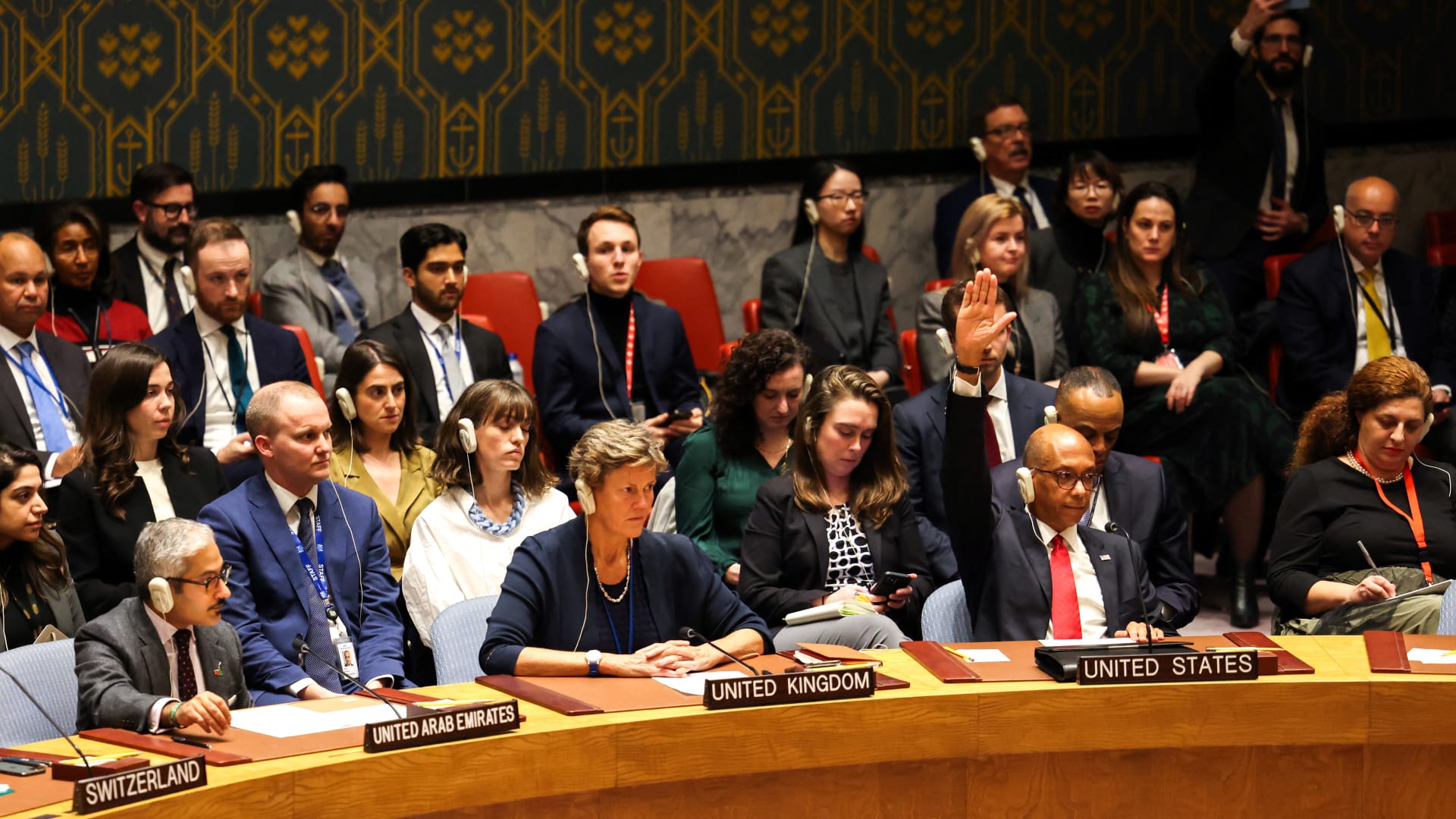
(CNN) — تباينت ردود الفعل على استخدام الولايات المتحدة الأمريكية، الجمعة، حق النقض (الفيتو) خلال تصويت في مجلس الأمن الدولي ضد مشروع قرار يدعو إلى وقف فوري لإطلاق النار في قطاع غزة.
ودعت نسخة مسودة مشروع القرار، التي قدمتها الإمارات، إلى “وقف فوري لإطلاق النار لأسباب إنسانية”، وكذلك “الإفراج الفوري وغير المشروط عن جميع الرهائن” و”ضمان وصول المساعدات الإنسانية”.
وانضمت ما لا يقل عن 97 دولة أخرى إلى هذا الجهد، وشاركت في رعاية مشروع القرار الذي صاغته الإمارات.
‘The video is hurting me’, says family member of Gazan man filmed being detained in underwear by IDF | World News
‘The video is hurting me’, says family member of Gazan man filmed being detained in underwear by IDF | World News
The brother of a Gazan man who was filmed being detained in only his underwear says the footage “hurts” to see.
The video circulating on social media appears to show dozens of Palestinians– some stripped to their underwear and some with their hands behind their heads – being held by the IDF.
Sky News cannot independently verify when the images were taken.
Mohammed Lubbad said his brother Ibrahim is among them.
“I look at the video, and it’s hurting me,” he said, adding, “they are so young, like 19 years. All of them are studying at university. It’s ridiculous.”
Follow latest: ‘At least 10 killed’ in Israeli strike
Image: Ibrahim was seen in an IDF truck carrying Palestinian prisoners
He also says the IDF “stripped and questioned” another 15-year-old brother yesterday.
“They took him. They took my brother who is 15 years, and they took off all his clothes and he cried,” he said.
He described what happened to those who were detained.
“All these people, they took them on the tanks and transported them… to the beach – which is horrific,” he said.
“They told me, ‘they tied our hands behind our backs for more than 20 hours. And they put us on the beach. We were freezing’.
“They were naked and they were freezing.”
Mr Lubbad said he was told those being held were questioned by the IDF “in the middle of the night”, with some people told to leave and others detained.
He added the IDF “released most of” those arrested.
“It’s like they are mocking us,” he said.
Image: Mohammed Lubbad
Israeli government spokesperson Eylon Levy told Sky News the arrests in northern Gaza were of “military age men who were discovered in areas that civilians have evacuated weeks ago”.
“Those individuals will be questioned and we will work out who indeed is a Hamas terrorist and who is not,” he said.
Mr Levy insisted it was “important” for those who were held to be questioned.
“Hamas fighters have been deliberately disguising themselves as civilians,” he said.
“We will work out who needs to be detained, arrested and put to justice.”
Please use Chrome browser for a more accessible video player
0:52
IDF spokesperson Daniel Hagari speaks after prisoner picture surfaces
Read more from Sky News: Data says more than half of Gaza hospitals no longer operational What happened after Hamas left the Nova festival site
Journalist detained by IDF
Among those who were held was Diaa al Kahlout, a journalist for London-based Qatari-owned news outlet Al-Araby Al-Jadeed, also known as The New Arab.
Mr Kahlout was seen in a dark navy blue vest among detainees.
Sherif Mansour, regional co-ordinator for the Committee to Protect Journalists (CPJ), demanded his immediate release.
He said the group is “deeply concerned” by reports of Mr Kahlout’s arrest, and said the IDF “should disclose his location, release him immediately, and take steps to ensure the safety of all journalists covering this war”.
Image: Journalist Diaa al Kahlout was among those detained yesterday
Lamis Andoni, editor and chief for Al-Araby Al-Jadeed, told Sky News the outlet last heard from the journalist “before he was arrested, while he was doing work as usual”.
She said: “His sister called and informed the organisation that he was taken from his home, and his little girl was left behind with his sister. They did not know where he was taken to.”
Why Israel is struggling to tackle Hamas’s alien tunnel network under Gaza | World News
Why Israel is struggling to tackle Hamas’s alien tunnel network under Gaza | World News
Despite overwhelming military superiority, Israel is struggling to develop an effective strategy to tackle the tunnel network under Gaza.
This “underworld” has provided Hamas with a degree of sanctuary beyond the gaze of satellites, drones and military forces.
How will Israel defeat Hamas without destroying the tunnel network?
Please use Chrome browser for a more accessible video player
0:41
Israel military destroys Gaza tunnels
The “Gaza metro” is bigger in scale than the London Underground network. Many of the tunnels were originally dug in the early 1980s to bypass the border between Egypt and Rafah, enabling the illegal smuggling of trade and weapons.
However, they have since been expanded into two further categories: defensive and offensive.
The former is primarily focused on the storage of weapons, logistic supplies (fuel, water and food) and command and control HQs, whereas the latter is an elaborate network of tunnels across the border into Israel to enable Hamas to take small-scale offensive action, and crucially to seize hostages.
Since assuming control of Gaza in 2006, Hamas has taken the development of the tunnel network to a new level.
The soft sandstone under Gaza is conducive to tunnelling, but Hamas has also adapted the network in response to Israel’s various attempts to destroy it.
Israel-Gaza latest: UN ceasefire vote fails
Please use Chrome browser for a more accessible video player
0:57
3D model of al Shifa tunnel
Bunker buster bombs could penetrate deep underground – and if they did not destroy a tunnel directly, the shifting sands would cause nearby tunnels to implode.
By digging the tunnels deeper – the main network is now over 20m (65ft) down rather than around 10m (32ft) for the original tunnels – Hamas made the tunnels far more difficult to target and destroy.
They have also been lined with reinforced concrete.
Tunnelling is not a new concept. Over 2,000 years ago, Jewish rebels used tunnels to revolt against Roman rule, and Viet Cong fighters exploited an extensive underground network in its (ultimately successful) war against US forces in Vietnam.
Most dynamically, it was in the First World War that tunnels were used to try to break the stalemate, where professional tunnelling engineers burrowed under enemy positions and used huge quantities of explosives to devastating effect.
Image: Israeli soldiers secure a tunnel underneath al Shifa hospital in Gaza
Hamas has long recognised that the tunnel network could provide an asymmetric advantage over its Israeli enemy, and by 2021 they claimed to have established a network over 500km (310 miles) long, which has provided a sanctuary away from Israel’s military might.
The Israel Defence Forces (IDF) claim to have discovered over 800 access shafts into the tunnel network, and it has destroyed or sealed over 500.
However, the tunnel network itself is too dangerous for the IDF to clear, so for now, it remains an underworld dominated by Hamas.
Read more from Sky News: Israel faces two big risks if it decides to flood the Hamas tunnels Video appears to show Israeli forces strip dozens of Palestinians Data reveals more than half of Gaza’s hospitals are no longer operational
Image: A Hamas tunnel shaft near a school
So how could Israel destroy the network?
The first challenge is to establish where the tunnels lie. The urban terrain makes them too difficult to locate via sensors, but using coloured smoke and sealing off an access point can track where the smoke emerges – known as the “Purple Hair” technique.
However, ultimately it is about entering the maze and plotting the network.
Then – how to destroy it?
Explosives can destroy sections of the network, but they can be cleared relatively easily and damaged sections reconstructed.
Image: A tunnel underneath al Shifa hospital in Gaza
Sealing up all access shafts renders the network unusable for a short time – but in a way also provides greater sanctuary for those underground as they have fewer entrances to protect.
This week, the Israelis have suggested they are planning to flood the tunnels with seawater. However, the tunnels are not all at the same level, so seawater might flood sections, but probably not the whole network.
The sandstone floors are porous, so huge quantities of water would need to be injected, and swiftly, to avoid the water simply draining away.
Also, some of the fresh water for Gaza comes from underground aquifers, and these would be contaminated – perhaps for some time – if salt water was to be introduced.
And finally, flooding would be indiscriminate – any hostages held in the tunnels (probably most) would be very vulnerable.
Please use Chrome browser for a more accessible video player
3:44
Could Israel ‘flood tunnels’?
Hamas has successfully identified that it is no match for the Israeli militarily, but the extensive tunnel network provides it with a very tangible asymmetric advantage.
It is unlikely that Israel will have the time – or appetite – to conquer this alien underworld. Instead, it is likely to endure as a stark reminder that there is no military solution to the conflict, and that military superiority does not always guarantee battlefield success.