Migrant deaths: Something must have gone wrong almost immediately | World News
Migrant deaths: Something must have gone wrong almost immediately | World News
Five people died in the waters off Wimereux.
It is, by any standards, a tragedy, but if you had just arrived here, you wouldn’t know anything had happened.
There is no big police operation to be seen. No grieving relatives, no incident tape or flowers left on the ground. No pack of journalists gathering outside a police station, and no wreckage.
In some ways, it is like nothing happened. Except, of course, for the emotional echoes – the crew who brought lifeless people out of the water, or the unfortunate person who went out for a morning walk along the beach and found a dead body on the rocks.
Outwardly, though, there is no sign that death lingered over this pretty town. Wimereux, like much of this stretch of northern France, has long since grown accustomed to the role migration plays in its life.
Locals here say they regularly see people hiding in the dunes, or rushing down to the sea. They know how inadequate these boats are and so, wearily, they also know that, sometimes, things will go wrong.
It used to be that there was a long lull in crossings during the winter months, but that trend has died away over the past couple of years.
Certainly it’s better to cross on a calm day in July, when the sun rises earlier and the sea is warmer. But those determined to reach Britain don’t want to wait for long months to get their chance, and people-smugglers will respond.
Supply and demand isn’t just for grocers, car showrooms and capital markets.
Read more: No small boat crossings over Christmas for first time in five years How did your MP vote on the Rwanda bill?
Please use Chrome browser for a more accessible video player
1:41
‘Rwanda plan won’t stop me crossing’
The reason why the lull came to an end is simple – the weather. Smugglers use phone apps that predict wind speed and sea conditions. Saturday was calm and the waves were small, which is why people set out for Britain. The early hours of Sunday morning were also marked by light winds, which is why the boat left Wimereux with around 70 people on board.
Something must have gone wrong almost immediately because it wasn’t far from the shore before people went into the water.
In the summer, they might all have been able to reach the shore – I have seen countless people in soaking wet clothing – but in the freezing temperatures we have now, the water was desperately dangerous.
The sea was reckoned to be nine degrees, the sort of level at which hypothermia can arrive quickly and awfully. Little wonder that many people were in a bad state and no surprise, either, that not everyone survived.
And so, once again, we are back to the question of what can be done to stop these crossings. It is a political quandary that has been fizzing for so long, with no clarity that it can be resolved easily, or perhaps at all.
And as the debate rumbles on, so the boats will keep leaving.
China criticises UK and US for congratulating winner of Taiwan election | World News
China criticises UK and US for congratulating winner of Taiwan election | World News
China has criticised the UK, US and other governments for congratulating the winner of Taiwan’s presidential election.
Beijing accused several nations of “interfering in China’s internal affairs” after world leaders sent messages to president-elect Lai Ching-te following his victory on Saturday.
China, which claims Taiwan as part of its territory and considers it a breakaway province, has accused Mr Lai and his Democratic Progressive Party (DPP) of being dangerous separatists.
The DPP says it favours the status quo of the island being self-governed but has not publicly called for independence.
The party’s win has been seen as a setback for Beijing and tensions heightened further on Sunday as it accused US secretary of state Antony Blinken of “sending a gravely wrong signal” after he sent his best wishes to the winner.
It came after Mr Blinken said: “We congratulate Dr Lai Ching-te on his victory in Taiwan’s presidential election. We also congratulate the Taiwan people for participating in free and fair elections and demonstrating the strength of their democratic system.”
But China‘s foreign ministry said it “strongly deplored and firmly opposed” the comments – and added that “serious representations to the US side” had been made.
“We urge the US to stop interactions of an official nature with Taiwan and stop sending any wrong signal to the separatist forces for ‘Taiwan independence’,” a spokesperson added.
Tensions have been further ramped up by a visit to Taipei by former US national security adviser Stephen Hadley and former deputy secretary of state James Steinberg on Sunday.
The pair are due to hold a string of meetings with political leaders, but are said to be doing so in a “private capacity”.
The US does not officially recognise Taiwan as an independent state and supports the status quo, although US President Joe Biden has promised to defend it from a possible attack by China.
It comes after Beijing also condemned the “incorrect actions” of Foreign Secretary Lord Cameron after he also congratulated Mr Lai – and described the elections as a “testament to Taiwan’s vibrant democracy.”
A Chinese embassy statement said on Saturday: “We urge the United Kingdom to acknowledge the position that Taiwan is a province of China, cautiously handle Taiwan-related matters in accordance with the one-China principle, [and] stop any remarks that interfere in China’s internal affairs.”
Read more from Sky News: Lai Ching-te’s victory the most provoking outcome to China Iceland volcano: Homes go up in flames Denmark’s new king proclaimed
The Chinese government further criticised a similar message from the Japanese government, and also hit out at France – even though officials in Paris did not name Lai or his party, and instead congratulated “all voters and candidates”.
On the eve of the election Chinese diplomats also warned Western nations of the unspecified dangers of supporting “Taiwan independence forces”.
Please use Chrome browser for a more accessible video player
2:52
‘Democracy is everything to us’
Xiao Qian, Chinese ambassador to Australia, published an article in The Australian on Friday which said: “If Australia is tied to the chariot of Taiwan separatist forces, the Australian people would be pushed over the edge of an abyss.”
Mr Lai’s victory means the DPP will continue to hold the presidency for a third four-year term, following eight years under President Tsai Ing-wen. He will take office in May.
Scale of vast tent city in Gaza revealed – with destruction leaving residents little to return to | World News
Scale of vast tent city in Gaza revealed – with destruction leaving residents little to return to | World News
Khalid Abo Middain used his hands, a hammer and a small shovel to build his own shelter on the outskirts of a fast-growing refugee camp near Rafah City in southern Gaza.
The father-of-three arrived there with his family after fleeing four times from Israel’s war against Hamas over the course of three months.
They originally left Bureij refugee camp in central Gaza after the war broke out and are unsure of what remains of their family home.
“I do not know how it is, because there is no means of communication at the moment,” he said, looking out at rows of makeshift tents.
“What is important is to find yourself in a place where you stay temporarily till this dark cloud is cleared.”
One hundred days into the war between Israel and Hamas, much of Gaza lies in ruins. Architecture and human rights experts say the scale of destruction and displacement is “immense” and unlike anything they’ve seen in Gaza before.
Since the start of the war, 1.9 million people have been displaced from their homes, according to the UN, and Rafah governorate is now the main refuge for those displaced. Over one million people have been crammed into a growing refugee camp that lies just north of Rafah City.
Satellite images show the camp’s expansion with an increasing number of makeshift shelters appearing on the outskirts of Rafah in just three weeks, between 3 and 31 December. The camp is the largest of its kind to emerge since the war began.
‘Everywhere is just so overcrowded’
“These spaces are not fit to hold the number of people that are being forced to live there,” said Nadia Hardman, a researcher at Human Rights Watch, who has been speaking to displaced Palestinians in the Gaza Strip, including Rafah. “Everywhere is just so overcrowded,” she told Sky News.
“What you have right now is more than half the population stuffed inside an area that was never meant to contain that many people. And the shelters that are being used are not designed for that purpose. So people are just making do, setting up tented spaces wherever they can.”
Satellite imagery from 6 January shows tents spilling out into the streets and parks of Rafah.
“We’ve never seen anything on this scale,” said Fatina Abreek-Zubiedat, assistant professor of architecture at Tel Aviv University, whose research focuses on transitional spaces in conflict zones.
By 6 January, the camp had exploded into a tent city of 2.9 sq km – equivalent to almost 400 football pitches.
The camp encompasses a UN facility, which was set up as a logistics hub for operations and as the main warehouse for basic food storage. It’s now doubling as a shelter, with hundreds of tents crowding inside and around the property.
“[People] are in an environment with limited to no services, with no reliable electricity, running water. So you can’t run a humanitarian operation in the way that you would want to,” said Hardman, the researcher at Human Rights Watch.
Rafah’s population has grown fourfold since the outbreak of war, according to the UN. The city lies along the border with Egypt, currently Gaza’s only access to the outside world. It is here where meagre aid supplies arrive, and where many Gazans await permission to flee the territory.
Aid organisations are under increasing pressure to provide humanitarian assistance to the growing number of people flooding the area.
“We’re gradually being cornered in a very restrictive perimeter in southern Gaza, in Rafah, with dwindling options to offer critical medical assistance, while the needs are desperately growing,” said Thomas Lauvin, Medecins Sans Frontieres project coordinator in Gaza.
Sky News journalists in Gaza visited the camp in Rafah.
Image: Eman Ismail Zweidi and her children look at photos from before the war
Many of the residents have built their own tents. Children’s clothes hang from makeshift washing lines as Gazans queue to fill up bottles and buckets against the backdrop of a sea of tents. Some families have even built their own bathrooms.
Eman Ismail Zweidi and her family set up their shelter in the western part of the camp. The seven of them had fled Beit Hanoun the day the war started and have been on the move until recently settling in Rafah.
Violence seemed to follow them everywhere they went. Two days after they arrived in Rafah, they learned the buildings they had been staying at just days before in Khan Younis were hit.
“We became very distressed by moving from one place to another,” she said. “Every new place we moved into was more difficult than the previous one.”
Image: Eman Ismail Zweidi’s family’s tents are located in the western part of the Rafah camp. Pic: Planet Labs PBC
On a crisp January afternoon, they gathered around Ms Zweidi’s phone, looking at images from their life before the war began. “Duaa! This is your first day in nursery. Do you remember when I photographed you and combed your hair?”, she said.
One of Ms Zweidi’s youngest daughters, Duaa, smiles at the camera, wearing pigtails and her school uniform.
Image: Duaa’s first day at nursery
“We could expect that these camps will exist not for months, but unfortunately, perhaps for years after the war will end,” said Irit Katz, associate professor of architecture and urban studies at Cambridge University, who has extensively researched the development of refugee camps in the Middle East and around the world.
The camp is on desert terrain and given the influx of displaced Gazans and limited supplies, conditions are worsening. The area lacks a sewage system and there is no running water or electricity. There is no centralised organisation inside the camp and families build their own homes.
“Usually, camps are created as temporary spaces that are supposed to exist only for a defined period. They’re not adequately linked to other environments,” said Ms Katz.
“People’s ability to inhabit them and to actually create a place that they could call home is very, very limited,” she said.
It’s difficult to gauge the exact number of people at the Rafah camp. And numbers keep growing as more people flee the violence farther north. It’s not just families, but also displaced individuals from areas in the north like Gaza City and Beit Hanoun.
Nearly two-thirds of the Gaza Strip is under Israeli evacuation orders, according to the UN.
In the remaining areas, satellite imagery analysed by Sky News shows that refugee camps made up largely of makeshift shelters have rapidly expanded.
But for these Gazans who have fled to camps for safety, there is little or nothing to return to. Satellite radar data shows the extent of the damage to buildings from Israeli strikes.
The destruction is especially severe in the north, where Gaza City has seen some of the fiercest bombardment of the war.
“We are talking about years, if not decades, that it will take to rebuild the original homes and areas of those currently displaced,” said Ms Katz, the Cambridge professor.
Palestine Square, in Gaza City’s Rimal neighbourhood, was home to a mosque, a school for deaf children and a fruit market. Satellite images show that the square has been completely destroyed.
Just under three kilometres north of the square was Gaza’s Blue Beach Resort. It was once described as “the first luxurious seaside vacation spot in the Gaza Strip”, with more than 150 rooms, several swimming pools and dotted with palm trees.
In early January, the IDF claimed it had “demolished” a network of Hamas tunnels underneath the hotel.
In some heavily damaged areas, Israeli forces have left other marks of their presence.
The satellite images below show two Stars of David, a Jewish symbol used on the Israeli flag, marked outside a school in Beit Hanoun (left) on the campus of the Islamic University of Gaza, in Gaza City (right).
Image: Stars of David visible outside a school in Beit Hanoun (4 December) and on the campus of the Islamic University of Gaza, Gaza City (7 January). Pic: Planet Labs PBC
In central Gaza, the destruction is equally as stark.
Bureij is a Palestinian refugee camp located east of the Salah al-Din Road which runs from the north to the south of the strip. In five weeks, dozens of fields and houses less than two kilometres away from the border with Israel were destroyed.
Tobias Borck, a senior Research Fellow for Middle East Security at RUSI, a thinktank, told Sky News “the future for Gazans looks pretty grim,” and added that in the context of displaced people in this war differs from many others.
“Israel is essentially fighting a war in a completely closed-off piece of territory. The people that live in Gaza cannot go anywhere,” he said.
“There are a few things about this war that are absolutely unique, and one is this question around refugees and displaced people… in the Israeli-Palestinian context, history suggests to the Palestinian people that every time they become refugees, they leave an area, and they are not able to go back.”
As for the future of who governs Gaza, Mr Borck said there has been some “push back” from the Israeli government to the international community to outline a plan for what comes next after the war.
“How is that going to happen? Who is going to pay for it? It remains a completely unanswered question”, said Mr Borck of rebuilding and finding political control in Gaza.
“This next challenge is at a completely different scale,” he said.
“For quite a long time we will be watching what is a devastating, unsustainable humanitarian crisis that is sustained because no one comes up with a workable solution.”
Additional reporting from Sky News’ Gaza team.
The Data and Forensics team is a multi-skilled unit dedicated to providing transparent journalism from Sky News. We gather, analyse and visualise data to tell data-driven stories. We combine traditional reporting skills with advanced analysis of satellite images, social media and other open source information. Through multimedia storytelling we aim to better explain the world while also showing how our journalism is done.
World’s richest men ‘double their wealth’ in three years – as Oxfam warns of first trillionaire | World News
World’s richest men ‘double their wealth’ in three years – as Oxfam warns of first trillionaire | World News
The world’s five richest men have more than doubled their fortunes to £688bn in three years – while the wealth of the poorest 60% has fallen, according to Oxfam.
It says the first trillionaire could emerge within a decade but that poverty won’t be eradicated for 229 years.
The charity’s report, Inequality Inc, comes as business and political leaders meet for the World Economic Forum in the upmarket Swiss ski resort of Davos.
It’s traditionally used the occasion to highlight the divide between rich and poor, but this year says the gap has been “supercharged” since the pandemic.
The fortunes of Tesla boss Elon Musk, Bernard Arnault – owner of luxury goods firm LVMH, Amazon founder Jeff Bezos, Oracle’s Larry Ellison and investment guru Warren Buffet, have increased 114% in real terms since 2020, says Oxfam.
Their collective wealth is said to have grown from £321bn to £688bn.
Musk alone is estimated to be worth about £180bn, according to the real-time Forbes list Oxfam used for its calculations.
However, the 4.7 billion people who make up the world’s poorest 60% have become 0.2% poorer in real terms, Oxfam says, with many countries unable to give the COVID financial support of richer nations.
Image: Davos is again hosting the renowned annual economic summit
The charity’s interim boss says the prospect of a trillionaire in the next 10 years – while poverty could take 200-plus years to resolve – was “totally unacceptable”
“This ever-widening gulf between the rich and the rest isn’t accidental, nor is it inevitable,” said Aleema Shivji.
“Governments worldwide are making deliberate political choices that enable and encourage this distorted concentration of wealth, while hundreds of millions of people live in poverty.
“A fairer economy is possible, one that works for us all. What’s needed are concerted policies that deliver fairer taxation and support for everyone, not just the privileged.”
Read more: What is Davos and what happens there? Billionaires’ huge carbon footprints prompt call for action
Oxfam is hoping its report can help pressurise policymakers in Davos for the 15-19 January summit.
Among those attending are Ukraine’s President Volodymyr Zelenskyy, Argentina’s new president Javier Milei, Chinese Premier Li Qiang, and European Commission chief Ursula von der Leyen.
Oxfam wants governments to reduce corporate power by measures such as breaking up monopolies, capping bosses’ pay and bringing in higher taxes on excess profit and wealth.
It’s also pushing for alternatives to the shareholder model, such as forms of employee ownership, and more fair-trade businesses.
الجيش الأمريكي: إسقاط صاروخ أطلق من منطقة يسيطر عليها الحوثيون نحو مدمرة
الجيش الأمريكي: إسقاط صاروخ أطلق من منطقة يسيطر عليها الحوثيون نحو مدمرة
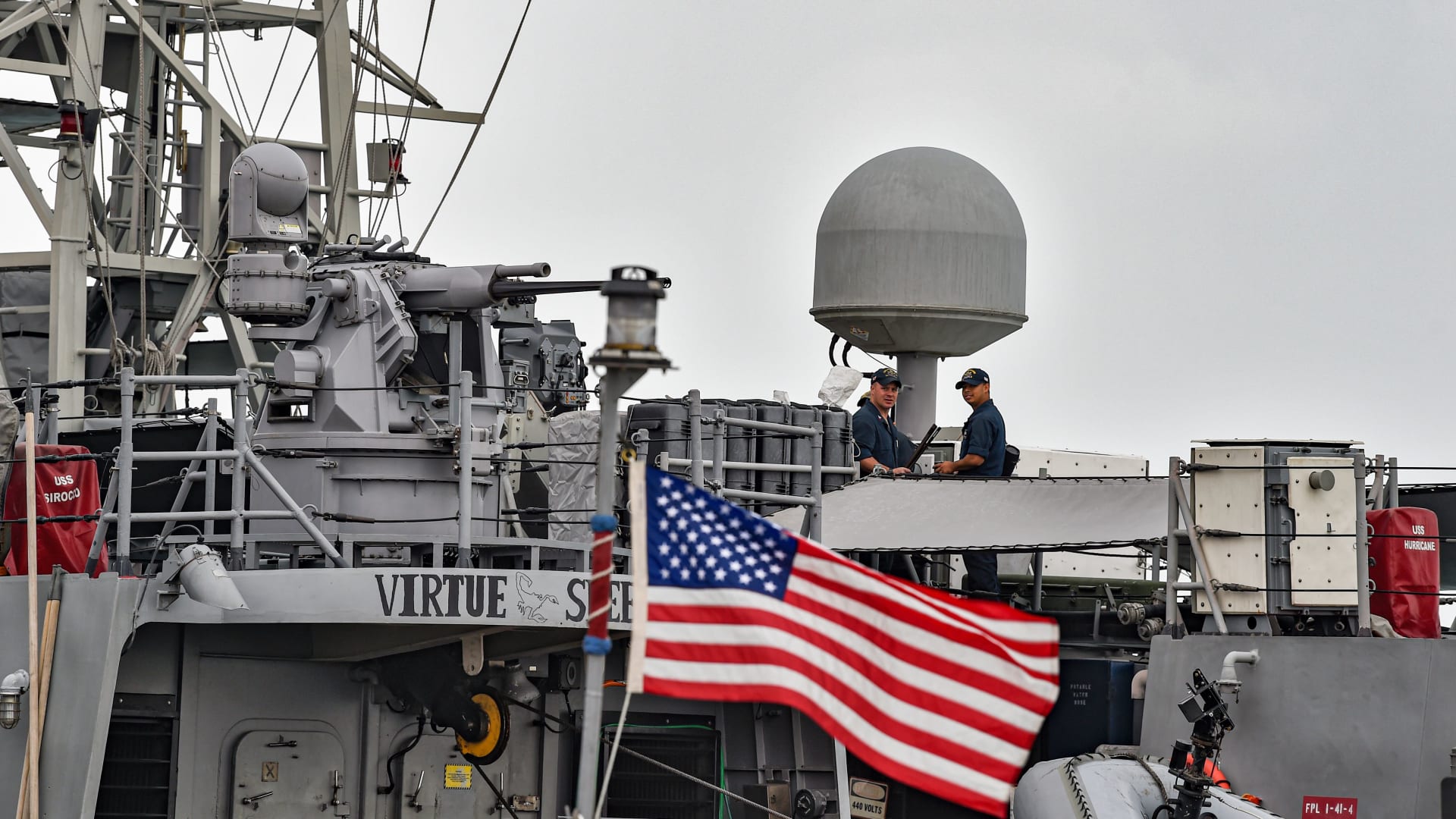
(CNN)– أسقط الجيش الأمريكي، الأحد، صاروخ كروز مضاد للسفن أطلق من منطقة يسيطر عليها الحوثيون في اليمن، وفقا لبيان صادر عن القيادة المركزية الأمريكية.
وقالت القيادة المركزية، في بيان عبر منصة “إكس”: “تم إطلاق الصاروخ باتجاه المدمرة الأمريكية يو إس إس لابون التي كانت تعمل في جنوب البحر الأحمر وأسقطته طائرة مقاتلة أمريكية في قبالة ساحل مدينة الحديدة”.
وأضافت: “لم يتم الإبلاغ عن وقوع إصابات أو أضرار”.
يذكر أن منسق الاتصالات الاستراتيجية بمجلس الأمن القومي الأمريكي، جون كيربي، قال،…