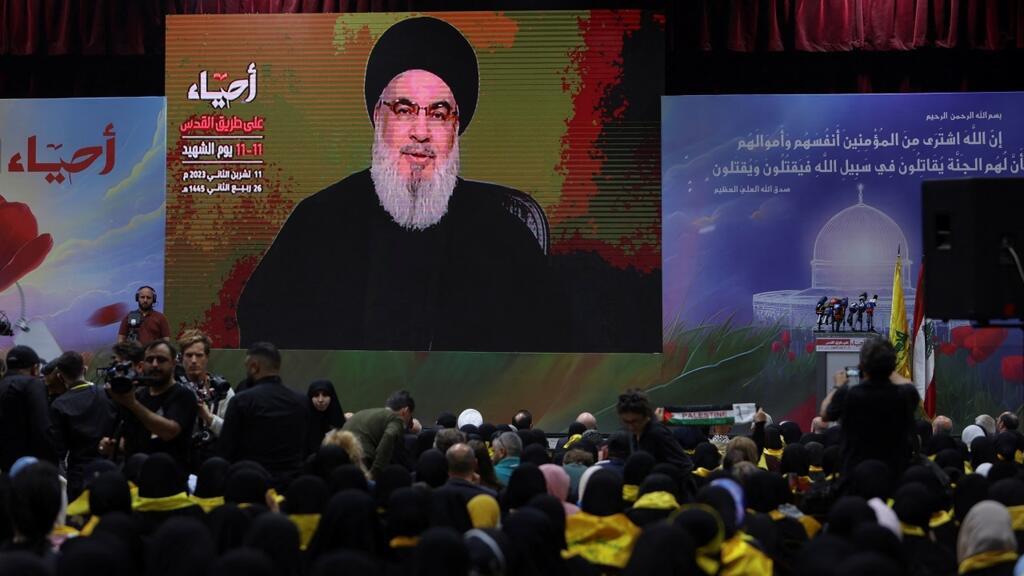
حزب الله يتعهد مواصلة العمليات ضد إسرائيل وغالانت يهدد سكان بيروت بمصير أهل غزة
حزب الله يتعهد مواصلة العمليات ضد إسرائيل وغالانت يهدد سكان بيروت بمصير أهل غزة
تعهد الأمين العام لحزب الله اللبناني حسن نصر الله السبت في ثاني خطاب له منذ بدء الحرب بين حماس وإسرائيل، مواصلة العمليات على الجبهة الجنوبية ضد العدو اللدود للجماعة الشيعية المدعومة من إيران. بعد ذلك بوقت قصير، قال وزير الدفاع الإسرائيلي يوآف غالانت إن الحزب يجر لبنان إلى الحرب محذرا من أن المدنيين اللبنانيين هم من “سيدفع الثمن”. وقال غالانت: “ما نفعله في غزة يمكن أن نفعله في بيروت”.
نشرت في:
4 دقائق
أعلن حسن نصر الله أمين عام حزب الله اللبناني السبت عن استخدام الجماعة التي تدعمها إيران، أنواعا جديدة من الأسلحة وقصفها أهدافا جديدة في إسرائيل خلال الأيام القليلة الماضية، متعهدا بأن تواصل العمليات على الجبهة الجنوبية ضد عدوها اللدود.
وهذا الخطاب الثاني لنصر الله منذ اندلاع الحرب بين حركة حماس وإسرائيل في 7 أكتوبر/تشرين الأول. وفي خطابه الأول في وقت سابق من هذا الشهر، قال نصر الله إن هناك احتمالا لتحول القتال على الجبهة اللبنانية إلى حرب شاملة.
اقرأ أيضامقتل صحافي وإصابة ستة آخرين أثناء تغطيتهم لإطلاق نار على الحدود بين لبنان وإسرائيل
وذكر نصر الله السبت بأن هناك “ارتقاء” في عمليات الحزب على طول جبهته مع إسرائيل. وأضاف في خطاب بثته محطات التلفزيون أن هناك “ارتقاء كمي على مستوى عدد العمليات وحجم الاستهدافات، عددها، وأيضا ارتقاء على مستوى نوع السلاح”.
وقال إن جماعته استخدمت صاروخا يعرف باسم البركان، واصفا وزن حمولته المتفجرة بما يتراوح بين 300 و500 كيلوغرام. وأكد أنها استخدمت طائرات مسيّرة مسلّحة لأول مرة. وأردف نصر الله قائلا إن حزبه استهدفت أيضا بلدة كريات شمونة شمال إسرائيل للمرة الأولى ردا على مقتل ثلاث فتيات وجدتهن في وقت سابق من هذا الشهر. وتعهد باستمرار القتال قائلا: “نحن في هذه الجبهة نواصل العمل”.
يوآف غالانت: “ما نفعله في غزة يمكن أن نفعله في بيروت”
بعد ذلك بوقت قصير، قال وزير الدفاع الإسرائيلي يوآف غالانت لجنوده قرب الحدود اللبنانية الإسرائيلية إن “حزب الله يجر لبنان إلى حرب قد تحدث”. وقال غالانت: “إنه (الحزب) يرتكب أخطاء وأن الذي سيدفع الثمن في المقام الأول هم المواطنون اللبنانيون. ما نفعله في غزة يمكن أن نفعله في بيروت”.
כולם ראו השבוע את תושבי עזה בורחים מבתיהם עם דגלים לבנים – אם חיזבאללה ימשיך במעשיו, תושבי ביירות עלולים להגיע למצב זהה. דברים שאמרתי היום ללוחמינו בגבול הצפון: pic.twitter.com/hRbY1Vmcba
من جانبه، قال المتحدث باسم الجيش الإسرائيلي الأميرال دانيال هاغاري إن الطائرات المقاتلة والمدفعية قصفت أهدافا كثيرة لحزب الله ردا على إطلاق النار عبر الحدود. وقال الجيش إن إسرائيل قصفت أيضا أهدافا في سوريا ردا على إطلاق صواريخ من هناك.
ويتبادل حزب الله إطلاق النار مع الجيش الإسرائيلي على الحدود منذ 8 أكتوبر/تشرين الأول. إلا أن القصف المتبادل اقتصر إلى حد كبير على المناطق الحدودية وقصف الحزب في الغالب أهدافا عسكرية، ومع ذلك قُتل ما لا يقل عن 70 من مقاتليه إلى جانب عدد من المدنيين اللبنانيين.
نصر الله: “العمليات مستمرة رغم كل الإجراءات الوقائية”
كذلك، قال نصر الله إن “العمليات مستمرة منذ 8 أكتوبر/تشرين الأول وحتى اليوم. رغم كل الإجراءات الوقائية استمرت عملياتنا في الجبهة في ظل الحضور الدائم للمسيّرات المسلحة الإسرائيلية التي شكلت عاملا جديدا في المواجهة.. إن أي خطوة إلى الأمام في جبهة لبنان هي بمثابة عمل استشهادي، وهذا يعبّر، من خلال حجم العمليات اليومية، عن مدى شجاعة وصلابة المجاهدين الاستشهاديين”.
اقرأ أيضاريبورتاج: آلاف النازحين بمدينة صور جنوب لبنان بحثا عن الأمان وخوفا من تداعيات الحرب المتواصلة
ويعد حزب الله، الجماعة المسلحة الشيعية التي أسسها الحرس الثوري الإيراني عام 1982، بمثابة رأس الحربة لمحور معاد لإسرائيل والولايات المتحدة تدعمه طهران.
وتقصف الدولة العبرية بشدة قطاع غزة الذي تديره حماس في أعقاب الهجوم الذي شنته الحركة عبر الحدود في وتقول إسرائيل إنه أسفر عن مقتل حوالي 1200 شخص واقتياد حوالي 240 شخص إلى القطاع الفلسطيني واحتجازهم هناك. وتقول السلطات الصحية في غزة إن أكثر من 11 ألف شخص، كثير منهم نساء وأطفال، قتلوا منذ أن بدأت تل أبيب هجومها على القطاع الساحلي الصغير الذي يبلغ عدد سكانه 2.3 مليون نسمة.
‘A real hell’: The climate refugees of Libya’s floods and regional strife | Floods
‘A real hell’: The climate refugees of Libya’s floods and regional strife | Floods
Often, in the middle of the night, Khadijah can hear screaming.
It could be the woman in the classroom next door, who has refused to change out of her abaya since Libya was hit with deadly floods on September 10. She fears more floods are on the way and wants to remain hidden from them, in the belief that her flowing robe will protect her, says Khadijah, 60.
Or perhaps it’s any one of many who saw their mother, father, child or grandparent swept into the sea when the dams burst above the eastern city of Derna, submerging it and its sleeping populace.
“The living are the ones who suffer; the dead are relieved,” Khadijah told Al Jazeera.
Khadija is one of thousands of people from the flood-battered city who have taken shelter in government schools after their houses were destroyed. She says she feels humiliated.
“Imagine closing your eyes on your own bed and then suddenly finding yourself lying on the cold floor of a public school,” she said, wiping away tears.
“I experienced most wars and disasters, [Muammar] Gaddafi’s siege of the city in the 1990s, the ISIS [ISIL] war in 2016, and the war of [Khalifa] Haftar’s forces in 2018, but what happened now was different [and] what came after it was more humiliating,” she added solemnly.
Khadija, her relatives, the 20 or so other families at the school they’re sheltering in, and the hundreds sheltering elsewhere are now “climate refugees”, the informal term used for those displaced by environmental disasters.
The public school where Khadijah and her family are sheltering [Ala Drissi/Al Jazeera]
But Derna was itself a refuge for thousands of migrants from neighbouring nations, alongside Libya’s own internally displaced population who settled in the coastal city from other parts of the country.
While the reasons they fled vary, climate-induced pressures compound with factors such as conflict and poverty, a complex web driving displacement in the region that will only continue in the years to come, experts have said.
Pushed out slowly – or all of a sudden
Khadija and other Libyans from Derna are entangled in this complex web but the stage was already set for the disaster that engulfed their homes and loved ones.
Storm Daniel was up to 50 times more likely to occur and 50 percent more intense because of human-caused climate change, according to the World Weather Attribution group.
The ailing, mismanaged dams were a key factor, as well.
“It can’t really be [overstated] how important the infrastructure issue is, because that’s one of the main catalysts for climate displacement,” Benjamin Freedman, an analyst at the Middle East Institute, told Al Jazeera.
The failing dams, alongside migrants “who weren’t necessarily properly settled”, created the “perfect storm for an outrageous humanitarian disaster”, he added.
While the flash flood created a sudden push for survivors to flee, most people who leave their lands for environmental reasons do so due to “slow-onset conditions” like multi-year droughts, Aimee-Noel Mbiyozo, a senior research consultant at the Institute for Security Studies, told Al Jazeera.
Before the floods, Libya was host to more than 705,000 refugees and migrants from more than 44 nationalities, according to Michela Pugliese, a migration and asylum researcher at Euro-Med Human Rights Monitor.
More than 230,000 of these refugees and migrants were living in eastern Libya, the part of the country devastated by the storm, the majority having arrived from neighbouring countries like Chad, Egypt, Niger, Nigeria and Sudan, she added.
Some 8,000 of them lived in Derna specifically, but it is likely that many others were present and not officially reported, said Pugliese.
While the reasons they ended up in Libya varied – many hoping to ultimately depart to Europe – some left their homes over lost livelihoods because of climate disasters.
“A lot of people coming [to] Libya from Chad, Sudan, and Niger were employed in the agricultural sector at home and came to Libya after having lost crops or livestock assets due to climate events like drought or floods,” Pugliese said.
A view shows the destruction in the aftermath of the floods in Derna, Libya [Esam Omran al-Fetori/Reuters]
International law doesn’t recognise climate refugees
Discerning just how many of Derna’s 8,000 refugees were climate refugees, and how many Libyans have now become climate refugees due to the floods, is a challenge – largely because that term doesn’t exist under international law.
“This term has no legal basis under refugee law yet, so neither UNHCR [the UN refugee agency] registering asylum seekers, nor legal desks aiding migrants, would use this as an official category,” said Pugliese.
Mbiyozo added that people who move for climate-linked reasons rarely identify it as such.
“We ask people, why have you moved and they almost never say, ‘climate change’,” she said.
“They’re going to tell you it’s to find a better economic opportunity, so they’re moving for jobs or for livelihood. But then you have to go a level deeper and say, ‘Well, what’s changed?’”
In West Africa, for example, a refugee may be fleeing Boko Haram because the armed group took their cattle due to dwindling resources, she said.
Climate change in the context of migration, therefore, is a “fragility amplifier or a threat amplifier”, said Mbiyozo.
Freedman said that, as climate disasters become more common, there needs to be a system in place to identify people fleeing because of them.
When these groups of people attempt to claim asylum in Western countries specifically, they are denied at a much much higher rate due to the arbitrariness of the category, he said.
But the situation will only continue to worsen, “especially when we’re dealing with potentially 1.2 billion people displaced internally and externally by intensifying climate weather events by 2050,” Freedman added.
Mbiyozo argued, however, that if the laws were rewritten, namely the UN Refugee Convention of 1951, a lot of Western countries “would pull back what they currently offer”.
“Everybody in the refugee space knows intuitively that if you were to redraw these things, you get less protection because that’s the political climate right now,” she said, adding that Italy, for example, is trying to deny as many asylum seekers as it can.
A boy, who survived the deadly storm that hit Libya, jumps as he plays with his brothers inside a classroom at the school where they shelter in Derna, Libya [Zohra Bensemra/Reuters]
‘Nothing but promises’
Despite an unwillingness from Western countries to take on new categories of refugees, experts say most climate-linked movement stays local, with many pushed from rural areas to urban cities.
Among the 40,000 people displaced in Libya’s floods, many moved to towns and villages further east and several hundred moved west, said Pugliese.
Among them, are the “twice-displaced” too, pushed from their countries to Libya, and then pushed again from Derna to elsewhere.
“It is far too early to tell what will happen to [these displaced peoples], as for now the response is still purely a humanitarian one,” said Pugliese.
Back in Derna, Khadijah is resolute that she and her family cannot stay at the school much longer.
Pulling one of her granddaughters close, she asked: “What is this child’s fault? Kids her age are studying in schools, and she lives here.”
Some of the women at the school hold back from going to the toilet due to concerns about privacy, and the classrooms are frigid at night even though winter has yet to come, Khadijah said.
She says she has “seen nothing but promises from the government”.
“We are living a real hell,” said Khadijah.
A man inspects damaged buildings, in the aftermath of a deadly storm and flooding that hit Libya, in Derna, Libya [Esam Omran Al-Fetori/Reuters]
Palestinians in Lebanon disappointed that Hezbollah won’t escalate | Israel-Palestine conflict News
Palestinians in Lebanon disappointed that Hezbollah won’t escalate | Israel-Palestine conflict News
Sabra and Shatila, Lebanon – A week after a much-anticipated speech about Israel’s assault on Gaza that did not declare war on Israel, Hezbollah reiterated that message on Saturday.
While it would keep retaliating against Israeli attacks on south Lebanon, Hezbollah leader Hassan Nasrallah said, the war with Israel would be long and victory would “take years”.
His message fell short for many Palestinians in Sabra and Shatila, a Palestinian refugee camp that sprawls out across two Beirut neighbourhoods.
“I wanted him to open up the war completely,” said Abdallah*, 25, one of the Palestinians who gathered anxiously at a sidewalk cafe in Sabra and Shatila to watch the speech.
He is one of nearly 250,000 Palestinians languishing in impoverished refugee camps in Lebanon since they were expelled from their homeland during the creation of Israel in 1948.
They have watched, horrified, as Israel systematically and deliberately targeted civilian structures like refugee camps, schools, and hospitals in Gaza.
Palestinian children wounded in Israeli air raids wait for treatment at Nasser hospital in Khan Younis in the southern Gaza Strip, November 12, 2023 [Mohammed Salem/Reuters]
The attacks have killed more than 11,000 Palestinians – nearly half of them children – and forced hundreds of thousands to flee to the south of Gaza, most of them on foot and often being attacked by Israeli troops even as they fled.
“Hezbollah is fighting and they’re trying, but we want them to make more happen,” said Abdallah.
Not enough pressure
Some Palestinians in Lebanon believe that Hezbollah should take the fight to Israel first.
Since Nasrallah’s earlier speech on November 4, there has been, an uptick in violence between Hezbollah and Israel in south Lebanon. On November 5, an Israeli rocket killed one woman and three children.
According to an Israeli army spokesperson, Hezbollah retaliated by killing an Israeli – with no information about whether the victim was a soldier or civilian.
Just moments before Nasrallah’s speech on November 11, Israel fired a rocket at a Lebanese village roughly 40km (25 miles) from their shared border.
Then, after the speech, Israel’s Defence Minister Yoav Gallant warned that Hezbollah was “close to making a grave mistake”, although it is not clear what he was referring to.
Majdi*, who lives in Shatila, said he is frustrated with Hezbollah.
He expected Hezbollah to assume a more significant role in helping Hamas because the group, he noted, has long posed as a leader of the so-called “axis of resistance”, which includes Iran, Hamas, and other Iran-backed armed groups in the region.
“Nasrallah will escalate against Israel from Lebanon a little bit, but he’s not going to be a partner with Hamas in the big and decisive battle in Palestine. He said that himself,” Majdi told Al Jazeera.
Internal pressure
Nicholas Blanford, an expert on Hezbollah with the Atlantic Council think tank, told Al Jazeera that Nasrallah, who is backed by Iran, is clearly considering his domestic situation.
In his speech, Nasrallah said there were “dissenting voices in Lebanon, but these voices are limited”.
Some Palestinians watching the speech in Sabra and Shatila believe Nasrallah was referring to Samir Geagea, a Christian politician who heads the Lebanese Forces party.
Geagea reportedly told a local television station that Lebanon did not need something “adding to all the miseries of the Lebanese people” shortly after Hamas’s surprise attack on Israel on October 7.
“Dragging Lebanon into a destructive war will do Hezbollah no favours,” Blanford said. “But the buck stops with Tehran. If the Iranian calculus changes and they want Hezbollah to go [into Israel] full scale, then Nasrallah will have to obey, irrespective of the backlash.”
A significant escalation between Hezbollah and Israel could lead to civil strife in Lebanon and the scapegoating of Palestinians, said Abdallah. But he still wants Hezbollah to take more pressure off Palestinians in Gaza.
Supporters shout slogans and wave Palestinian and Hezbollah flags, as they await the speech by Hassan Nasrallah, at a rally in Beirut, Lebanon, November 3, 2023 [Hussein Malla/AP Photo]
“The reason I want Hezbollah to escalate is because all I see is Israel killing children. I’m against killing children, regardless if they’re Israeli or Palestinian,” he told Al Jazeera, moments before Nasrallah’s speech was broadcast on television.
Managing expectations
Some Palestinians believe Hezbollah is doing more than enough to help Gaza and blame other Arab leaders such as Egyptian President Abdel Fattah el-Sisi and Palestinian Authority leader Mahmoud Abbas for being complicit in Israel’s atrocities.
They believe the former has kept the Rafah border crossing with Gaza mostly shut and that the latter has looked to benefit from Israel’s war on Hamas.
“Egypt isn’t letting in enough food into Gaza or opening its crossing to help Palestinians get out,” said Razan*.
Baha*, also from Shatila, said Nasrallah is at least fighting Israel to some degree.
He adds that Abbas is the biggest traitor to Palestinians for continuing his security cooperation with Israel in the West Bank – a product of the 1993 Oslo Accords – and for offering to play a role in administering Gaza if Israel defeats Hamas.
“Hezbollah can’t do it alone,” Baha told Al Jazeera. “But right now, we all like Nasrallah more than our own Palestinian leader [Abbas].”
* The surnames of these Palestinian interviewees have been withheld due to their concerns for their safety.
Israel-Hamas war: List of key events, day 37 | Israel-Palestine conflict News
Israel-Hamas war: List of key events, day 37 | Israel-Palestine conflict News
As the conflict between Israel and Gaza enters its 37th day, these are the main developments.
Here is the situation on Friday, November 12, 2023:
The latest developments
Israel continues to target hospitals in Gaza from the air as its ground forces have also surrounded several hospitals in the northern part of the besieged enclave. Ahmad Mokhallalati, a surgeon at the al-Shifa Hospital, told Al Jazeera that medical staff and patients “are in the middle of the warzone”.
At least 13 Palestinians were killed in an Israeli strike on a house in Khan Younis, health officials in Gaza said on Sunday.
Are Israel and the United States not on the same page about the future of Gaza? Washington has asked Tel Aviv to clarify Prime Minister Benjamin Netanyahu’s comments on “not giving up security control of Gaza” that clash with US suggestions that the Palestinian Authority should take over the strip after Hamas is “destroyed”.
Hezbollah chief Hassan Nasrallah said on Saturday in his second speech since the start of the war that the Lebanese war front remains “active” and that the armed group has used new weapons against the Israeli military.
Major cities around the world, including New York, London, Melbourne, Paris, Baghdad, Karachi, Berlin and Edinburgh have continued to see large demonstrations, involving hundreds of thousands, in support of Palestinians and an immediate ceasefire. Thousands rallied in Tel Aviv on Saturday to call for the release of captives held by Hamas in Gaza.
Human impact and fighting
More than 11,000 Palestinians have been killed in the Gaza Strip since the start of the war. But the United Nations said on Sunday that the “collapse of services and communications at hospitals in the north of Gaza” is delaying the Ministry of Health in Gaza from updating the numbers.
The World Health Organization (WHO) has said it has lost communication with its contacts inside al-Shifa Hospital, and people have been targeted and killed while trying to get out.
At least two premature babies have died in the hospital due to power blackouts and dozens more are at risk.
Tens of thousands have fled the northern parts of Gaza in recent days as the Israeli military ramps up its operations there. But Israeli forces also continue to pound Rafah and other spots in the south, leaving no safe place in the strip. More than 70 percent of Gaza’s 2.3 million residents are now displaced.
Diplomacy
Leaders from across the Arab and Islamic world convened on Saturday in Riyadh as Saudi Arabia hosted members of the Organisation of Islamic Cooperation and the Arab League to discuss Gaza. They rejected justifying the Israeli aggression as self-defence and called for a ceasefire.
Tense talks are ongoing at the UN Security Council to break a deadlock that has prevented the world’s most powerful decision-making authority from having any real effect on stopping the killing of civilians. A new resolution has been circulated among members, coming after several failed efforts.
Ireland’s parliament is expected to vote next week, based on a motion by the left-wing Social Democrats, on whether it will expel the Israeli ambassador.
No respite for the occupied West Bank
Israeli forces continue to exponentially intensify their raids in the occupied West Bank. Sources in the Palestinian Authority have told Al Jazeera that the number of raids has increased to about 40 per day in the past week.
The number of Palestinians killed in the occupied West Bank since October 7 has now risen to 185, and about 2,500 Palestinians have been arrested by Israeli forces in that time.
Families, many of them carrying children, are trying to flee areas in the occupied West Bank that are heavily raided, including the Jenin refugee camp.
Tom Aspinall wins UFC interim heavyweight title with 69-second knockout | Sports News
Tom Aspinall wins UFC interim heavyweight title with 69-second knockout | Sports News
Tom Aspinall beat Sergei Pavlovich to become the first British heavyweight to win a UFC title, while Alex Pereira used a series of elbows to Jirí Procházka’s head to win the vacant light heavyweight championship in the UFC 295 title fights at Madison Square Garden.
Aspinall knocked out Pavlovich in the first round for the interim heavyweight championship on Saturday night in front of a packed crowd that included former President Donald Trump.
The interim title fight was a late addition to the card after the scheduled main event of Jon Jones vs Stipe Miocic in a heavyweight title fight was called off because Jones tore a pectoral tendon off the bone during training.
While UFC waits for Jones to return, it’s Aspinall who now holds the gold.
“It’s been a crazy 2 1/2 weeks,” Aspinall said.
His tearful celebration lasted longer than the fight. Aspinall needed only 69 seconds to earn his 11th career knockout win – he has made it to the second round just once in his eight UFC fights – and then collapsed in tears on the canvas.
Aspinall had landed consecutive rights to Pavlovich’s temple to send the Russian crashing to the canvas.
“He’s a big, scary guy,” Aspinall said. “I’ve never been as scared in my life as fighting this guy. But I’ve got a lot of power, too, and I believe in myself.”
Aspinall draped himself against the cage as fans roared for the new champ.
Pereira crowned light-heavyweight champ
In the co-main event, Pereira won his second UFC championship in just his seventh fight for the promotion.
Brazil’s Pereira, who knocked out Israel Adesanya on November 12 last year to win the middleweight belt before losing it in April in a rematch, had some early success with some vicious leg kicks, but Prochazka’s precise striking posed a problem.
Procházka had won 13 straight mixed martial arts (MMA) fights, including his first three in UFC.
The 31-year-old Czech continued to switch stances and press forward, but his aggression was eventually punished when he was caught out by some precise counter-punches by Pereira that paved the Brazilian’s path to victory and the fight was stopped at 4:08 of the second round.
Pereira became the ninth fighter in UFC history to win championships in two weight classes.
Pereira, left, punches Procházka during the second round [Frank Franklin II/AP Photo]
Pereira then used his post-fight interview to call on Adesanya to step up to light heavyweight and face him in a third title fight, saying “Adesanya, come to daddy.”
The light heavyweight division had been without a champion since Jamahal Hill relinquished the title in July after he was injured in a pickup basketball game. Hill was at the Garden to watch the fights.
He wasn’t the only name in the house.
Trump and musician Kid Rock were greeted by cheers and “USA! USA!” chants as they walked to their cageside seats ahead of the start of the main card. UFC President Dana White accompanied Trump and Kid Rock and watched the fights with them. Trump slapped hands with fans and mingled with visitors.
Former UFC 115-pound champion Jéssica Andrade snapped a three-fight losing streak with a TKO win over MacKenzie Dern at 3:15 of the second round. Andrade became the first woman in UFC history to earn four knockdowns in a single fight and tied Amanda Nunes for most wins in UFC women’s history with 16.
UFC has run a major card in November at Madison Square Garden every year (except for 2020) since New York legalised MMA in time for a 2016 debut. Conor McGregor, Georges St-Pierre and Daniel Cormier all headlined pay-per-views at MSG and this one promised to perhaps be the biggest main event yet – Jones defending his heavyweight crown against Miocic.
Jones, on the short list of great MMA fighters, tore a tendon during training last month and was forced to withdraw. White then deemed an interim championship fight was beneath a fighter of Miocic’s stature. The two-time heavyweight champ, Miocic has not fought since March 2021.
The bout could be rescheduled for as early as next summer, depending on Jones’ health.
“That’s the fight they want, that’s the fight that makes sense, that’s the fight that should happen,” White said.
Even without the anticipated fight, there was reason for the company to celebrate with 19,039 fans and a $12.4m gate at MSG. UFC now holds the top-three spots for highest gate at the Garden. Also, Sunday marks 30 years since the company’s debut show, UFC 1.
UFC Hall of Famer Royce Gracie won three fights that night in Denver in a no-rules tournament that was just the start for the billion-dollar company owned by Endeavor that now stands as the global leader in MMA.
UFC was built on personalities as much as great fights and New York native and recovering drug addict Jared Gordon gave fans at the Garden a reason to cheer.
Gordon scored his first KO since 2017 when he beat 2016 Olympic silver medal wrestler Mark Madsen in a prelims bout. Gordon has been open about his drug issues, overdoses and difficulty staying clean while pursing a brutal MMA career. He had a new reason to appreciate fighting in New York.
“I used to shoot heroin in Penn Station underneath this building,” he said. “Now I’m fighting in it and knocking guys out.”